Say Goodbye to Manual Inefficiency! Automatic Stretch Film Wrapping Machine Unlocks New Potential for Enterprise Packaging
Release time: 2026-04-15
In the closed loop of industrial production and logistics warehousing, the packaging process has always been a key link affecting efficiency and controlling costs. For enterprises that need to use a large amount of stretch film for packaging, the pain points of traditional manual wrapping have long become a “stumbling block” restricting development—time-consuming and labor-intensive, inconsistent packaging results, serious film waste, and rising labor costs year by year. Especially in scenarios with large batches of goods and diverse specifications, the shortcomings of manual wrapping are even more obvious.
As the wave of industrial automation sweeps across all industries, the automatic stretch film wrapping machine has emerged at the right time, fundamentally restructuring the efficiency and cost logic of the packaging link. It is not just a simple packaging device, but also an “intelligent assistant” for enterprises to reduce costs, increase efficiency, and enhance product competitiveness. Today, we will comprehensively analyze the automatic stretch film wrapping machine and see how it solves packaging problems for various industries and empowers high-quality enterprise development.
I.The “Dilemma” of Traditional Manual Wrapping—Are You Experiencing It Too?
Before introducing automatic packaging equipment, most enterprises face the same troubles in the stretch film wrapping link. Especially in industries with high packaging demand such as logistics, food, chemicals, and building materials, these pain points are more prominent:
- Low Efficiency and Limited Production Capacity: Manual wrapping relies entirely on hand operation. It not only requires manual stretching of the stretch film but also repeated adjustment of the goods position. Wrapping a pallet of goods usually requires 1-2 people to cooperate and takes 5-10 minutes. When orders surge in peak seasons, the packaging link is likely to become a “bottleneck” in production and logistics, failing to keep up with the rhythm of front-end production capacity and back-end delivery. Besides, manual wrapping is also inefficient and can hardly meet the large-scale production needs of enterprises.
- High Costs and Severe Losses: Labor costs are rising year by year, and long-term employment of professional wrapping workers will bring a lot of burden to enterprises. At the same time, manual operation cannot accurately control the tension and wrapping layers of the stretch film—either loose wrapping leads to scattered goods, or over-tight wrapping causes film waste. According to statistics, the film loss rate of manual wrapping can reach 15%-20%, which is a considerable expense accumulated over time. In addition, the high turnover rate of manual workers also increases the hidden costs of enterprises.
- Uneven Quality and Increased Risks: Manual operation relies entirely on experience. Different workers have different wrapping techniques and strengths, resulting in inconsistent packaging effects of the same batch of goods—some are loosely wrapped, making goods prone to collision, scattering, and moisture during transportation; some are irregularly wrapped, affecting the appearance of products. It may even lead to customer complaints and goods loss due to unqualified packaging, increasing the after-sales costs and reputation risks of enterprises. Moreover, inconsistent packaging quality will also affect the brand image of enterprises in the market.
- Complicated Operation and Safety Hazards: Long-term repetitive stretching and wrapping actions make workers prone to occupational injuries such as muscle strain. At the same time, manual wrapping requires close contact with equipment and goods. Especially in industries such as chemicals and building materials, where goods are heavy and irregular in shape, collisions, injuries, and other safety accidents are likely to occur, bringing safety management pressure to enterprises. The safety risks of manual wrapping also increase the difficulty of enterprise safety management.
The existence of these pain points makes more and more enterprises realize that traditional manual wrapping can no longer meet the needs of modern production. Introducing an automatic stretch film wrapping machine to realize the automatic upgrading of the packaging link has become an inevitable choice.
II.What Makes Automatic Stretch Film Wrapping Machines So Powerful?
Compared with traditional manual wrapping, automatic stretch film wrapping machines have completely solved the above pain points with their core advantages of intelligence and automation, bringing all-round improvements to enterprises in four dimensions: efficiency, cost, quality, and safety, and becoming the “efficiency leader” and “cost steward” in the packaging link.
1. Efficient Automation, Doubling Production Capacity
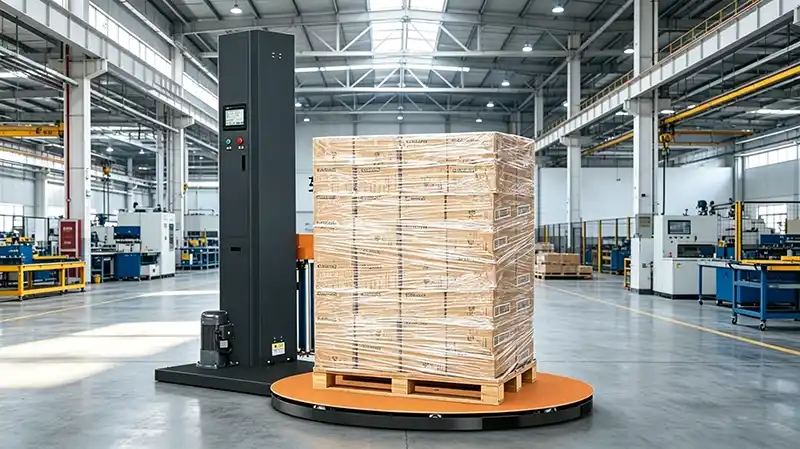
Automatic stretch film wrapping machines adopt a PLC programmable control system, equipped with a touch screen operation interface, requiring no manual intervention throughout the process. You only need to place the goods to be wrapped on the rotating platform, set parameters such as stretching ratio, wrapping layers, and rotating speed, and the equipment can automatically complete a series of processes such as film stretching, wrapping packaging, cutting and sealing, and discharging. It only takes 30 seconds to 1 minute to wrap a pallet of goods, and the efficiency is 5-10 times that of manual wrapping. In addition, the equipment can also be called an automatic stretch film packer, which is equally efficient and convenient.
What’s more worth mentioning is that the equipment can run continuously for 24 hours without rest, completely getting rid of the impact of factors such as manual fatigue and leave. It is especially suitable for scenarios with surging orders and batch wrapping in peak seasons, easily breaking the packaging bottleneck, helping enterprises improve overall production capacity, and keeping up with the market delivery rhythm. According to industry data, after introducing automatic wrapping machines, the overall efficiency of the enterprise’s packaging link can be increased by more than 60%, greatly shortening the production and logistics cycle. This efficient operation mode can also help enterprises gain more market competitiveness.
2. Precise Film Control Saves Costs, with Visible Cost Reduction Effects
One of the core advantages of automatic wrapping machines is the precise control of film materials. The equipment is equipped with a professional tension adjustment device and stretching roller group, which can accurately set the stretching ratio (usually 200%-500% pre-stretching) according to the weight and size of the goods, making the stretch film bear force evenly. It not only ensures the stability of the packaging but also avoids film waste. The film loss rate can be reduced to less than 5%, saving enterprises a lot of film expenses every year. This precise control function is also a major feature that distinguishes it from manual wrapping.
At the same time, the equipment does not require special personnel on duty. One equipment can replace 3-5 manual workers, greatly reducing labor employment costs and social security costs.
3. Stable Packaging Quality, Enhancing Brand Image
The core advantage of automatic equipment is “standardization”. Through precise parameter control, the automatic stretch film wrapping machine ensures that the wrapping force, layers, and flatness of each piece of goods remain consistent, without the problems of looseness, wrinkles, and skew caused by manual wrapping. The evenly wrapped film can not only better fix the goods, play the role of dustproof, moisture-proof, shockproof, and scratch-proof, reduce the loss of goods during transportation and storage, but also make the product appearance more regular and beautiful, enhancing the overall texture and brand image of the product. This stable packaging quality can also help enterprises win more customer trust.
For industries with strict packaging requirements such as food, medicine, and electronics, the standardized packaging of automatic wrapping machines can also meet industry compliance requirements, avoiding product scrapping and customer complaints caused by unqualified packaging, and further improving customer satisfaction and loyalty. The compliance of packaging is also an important guarantee for enterprises to enter the international market.
4. Safe, Convenient and Easy to Operate, Reducing Management Pressure
Automatic stretch film wrapping machines are equipped with multiple safety protection devices, including emergency stop buttons, photoelectric sensors, protective covers, etc., which can effectively avoid safety accidents of operators during the operation of the equipment, fundamentally solve the safety hazards of manual wrapping, and reduce the safety management pressure of enterprises. These safety protection devices also meet the safety standards of various countries and regions, making the equipment applicable to the international market.
At the same time, the equipment is simple to operate. Operators can proficiently master parameter setting, equipment start-up, daily maintenance, and other operations after simple training, without professional technical skills, greatly reducing the enterprise’s labor training costs. In addition, the equipment also supports parameter memory function. For goods of different specifications, parameters can be stored in advance and directly called when used later, further improving operation efficiency. This easy-to-operate feature also reduces the difficulty of enterprise personnel management.
Conclusion: Automatic Upgrade Starts from the Packaging Link
In today’s increasingly fierce market competition, reducing costs, increasing efficiency, and improving quality are the core competitiveness of enterprise survival and development, and the automatic stretch film wrapping machine is the key equipment to help enterprises achieve this goal. It can not only solve the pain points of traditional manual wrapping such as low efficiency, high consumption, and insecurity but also help enterprises save costs, improve efficiency, and optimize quality, allowing enterprises to gain an advantage in the fierce market competition. It is also called an automatic stretch film packaging machine, which plays an important role in the development of enterprises.